
Like Planes in the Night –a Driving Classical Music Aficionado and a Photographer Wearing the Paperboy’s Cap | 听古典的司机和戴童帽的摄影师
Written by: Chen Yan | 陈琰
Translated by: Neil McCallum
Editor’s Note:
This article is excerpted from Haha! Britain — a charitable bilingual publication co-produced by The Mothers’ Bridge of Love (MBL) and River Cam Breeze. The book is a lively collaboration between 42 Chinese authors living in the UK and 36 university-based volunteer translators. With wit and warmth, the stories capture the everyday realities of Chinese communities in Britain, offering an honest look at the cultural clashes, humour, and adaptation that arise in the space between Chinese and British ways of life. Haha! Britain has been warmly endorsed by several well-known figures in UK-China relations, including Stephen Perry (former Chairman of the 48 Group Club), Luise Schäfer OBE (former British diplomat and Chamber of Commerce chair), Professor Hugo De Burgh (former BBC editor and academic), and British scholar Martin Jacques. The book’s title was handwritten by celebrated British-Chinese artist Qu Leilei, its cover illustrated by bestselling Chinese author and poet Feng Tang, and the postscript contributed by Xue Mo, a prominent voice in contemporary Chinese literature.
Illustrated by Tian Tian
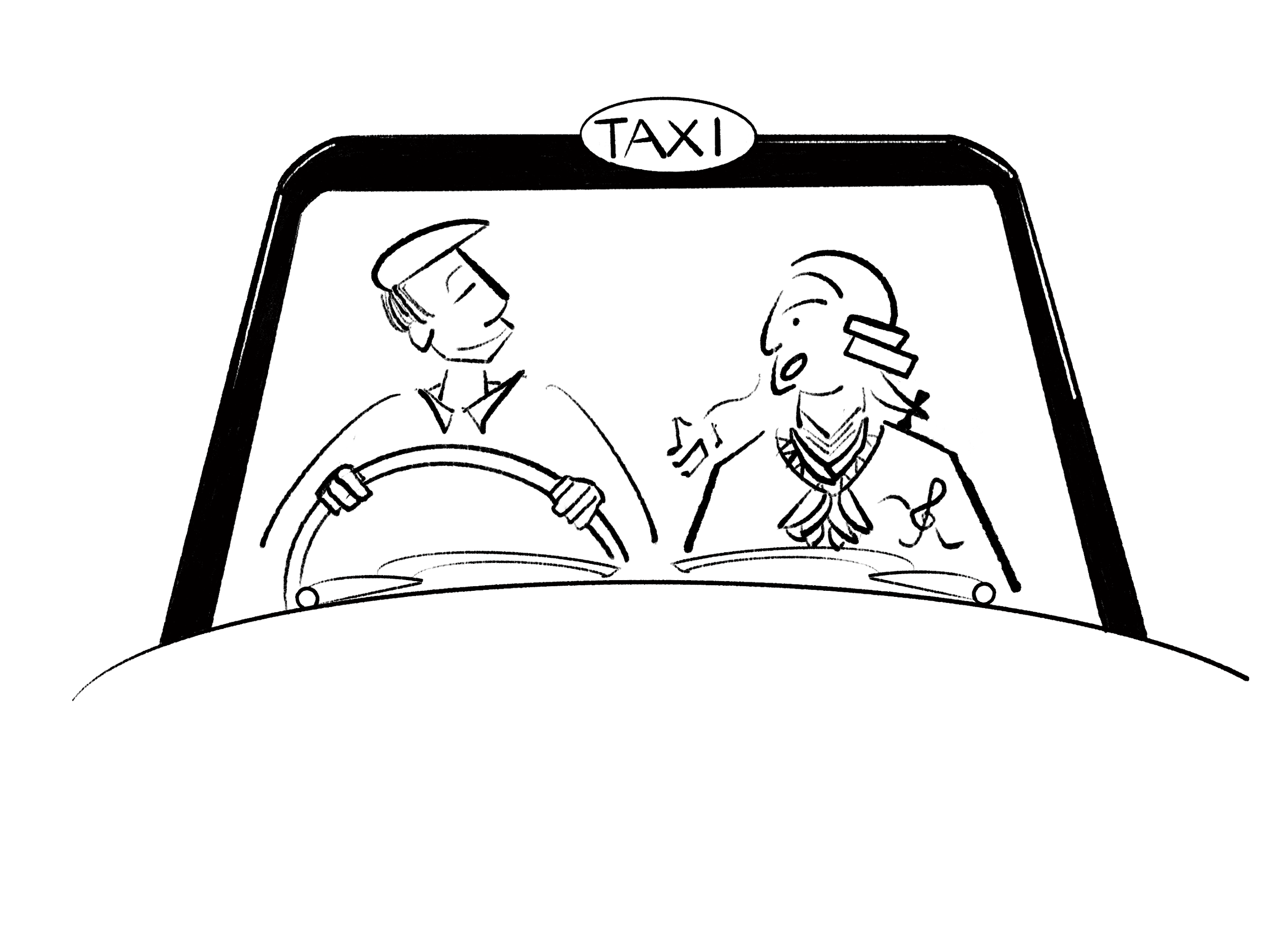
The car’s peculiar driver listens to classical music
Once, when on a business trip to London, I arrived at Heathrow airport in the early hours of the morning. Havingpassed through customs and grabbed my suitcase after it had gone round and round the conveyor belt, I finally got to the exit. There really isn’t much difference between day and night at an international airport. At the exit, there was a crowd ofpeople, and it took a few tries to find my taxi driver. The driver had been waiting around for a long time, and hadn’t pickedup my calls. I expected the driver to greet me, as most English people do, but he didn’t at first. After a day of rushing about,customs and baggage claim being useless when I got there, my patience was wearing thin. Although we both briefly said “hello” and “thanks”, there was a clear sense of impatience in the air.
I was in a hurry to go home, and he was in a hurry to take me to my destination. We both strode quickly towards thecar park. We didn’t waste any words; we just wanted to escape the airport as soon as possible. I got into the car, and he calmly sat down in the front after having put my suitcase in the boot. He started the engine, and I immediately heard classical music emanating from the speakers. In that very moment, my impatience and exhaustion washed away. It was as ifall the din from the airport five minutes earlier was stuck outside the window.
A tall, broad, bullish taxi driver with a bad temper can also listen to classical music. The music started when the engine started, and something about the driver indicated to me that he listened to it often – he wasn’t just trying to show off. Heknew the roads well and overtook others gracefully. His skill as a driver and his refined taste in music made me see him in anew light. My mum and dad always had friends from the world of classical music who’d say to me: just because someonelistens to classical music doesn’t make them a refined person. Historically, autocrats and evil people have either enjoyed orplayed classical music. But I think that anyone who listens to classical music can’t be all bad. Deep down in their heart, theremust be some uncorrupted areas that are enlivened when enjoying music.
I decided to strike up a conversation with the driver about classical music, but I was so tired that I slept all the way home. The car pulled in to stop, and the driver called out to me a few times before I woke up. “Sorry, I fell asleep and didn’t hear you speaking.” He said, “No worries. It really is late now.” Then we parted ways with the same thank youroutine; the mood and atmosphere were very different from when we first met. Perhaps it was the impact of time or the power of music, but our moods were calmer. I spent about an hour with this driver. I don’t even know his name or where helived, but together, in silence, we listened to several pieces of classical music on the road from one side of London to the other, from west to east.
John the photographer
John is a middle-aged photographer hired to photograph various events related to his employer. In this era of self-media where anyone can write, direct, act and publish their own works with a mobile phone, he always carries a heavySLR camera and telephoto and short focal length lenses. His appearance is very recognisable, not because of his figure, butbecause of his clothes. He likes to wear long, waterproof and windproof coats, and his shoes are usually indigo or darkbrown suede. If the occasion is more formal, he will wear a shirt and a tie or bow tie. However, no matter the season, regardless of whether he is indoors or outdoors, he always wears a plaid paperboy cap, which is quite stylish. As a personwho cares about appearances, I am inclined to pay more attention to men who dress well. Living in the UK, where people pay attention to the “dress code”, it is a pleasure to observe what men and women of all ages wear on different occasionsand in different seasons.
However, John seemed to have sort of dislike for me. Over the course of a few years, we’d cross paths a few times a year because of my work in the media. When waiting to conduct an interview, there was always some downtime before the interviewee arrived, during which it seemed appropriate to make polite conversation. It was during these moments that I sensed he held something against reporters like me, who both wrote and took pictures. It’s as if he felt that we weresomehow inadequate and stealing his job.
When I met him again a few years ago at the annual Spring Festival celebration at Trafalgar Square in centralLondon, he was different from his usual self. This annual celebration is not only a major event for the Chinese community, but also a major event for London. Visiting this celebration every year means entering a battle of wits with talllocal media photographers and on-site security guards. These photographers’ images are either taken to compete for timeliness or to make money. They demonstrate a kind of wolfish nature rarely witnessed in the British workplace. Thesephotographers are seasoned at warding off journalists like me with their long lenses. But not John. His photos are releasedexclusively so he doesn’t need to compete for the first release.
I arrived at the celebration early, hoping to snag a spot that would allow me the best angles. It hadn’t crossed my mindthat John would also be there. As usual, we said hello to one another. John knew that I was doing double duty as aphotographer and reporter, and on this occasion he very kindly allowed me to have a spot in front of him. While waiting forthe show to start, he helped me defend my “territory” several times. He also taught me how to capture the coveted shot ofthe lion flying over the dome of the National Gallery during the lion dance. This was the first time I had ever gotten thatshot in my entire career. The next day, this photo went on the front page of the publication I was working for. When my manager praised me, I silently said in my heart thanks to John.
I was humbled by his proactive offer of help that day. Perhaps he thought that since he couldn’t get rid of me, he should just get along with me. But I believe his intention was simply to be kind. His thoughtfulness warmed my heart.
I still remember that before the event started, the guests were socialising in the VIP tent with their hot drinks,chatting and shivering in the cold wind. Talking about transformations in the industry, John, who has been shooting this event for over a decade, said with emotion, “Another year, and I am a year older.” I always thought he considered himselfto be above us, but it was touching to see him be vulnerable. That humanised him considerably in my mind.
During our hectic lives, there will always be many people and things who pass us by. Although these encounters mayamount to nothing and the journey itself is not necessarily thrilling, the fragments of these warm memories will sometimescome to mind. This is the spice of life. With them, a clear noodle soup can be transformed into a broth of a hundred flavors.And, it is because of these ephemeral meetings that I feel more alive.
About the author
Chen Yan has lived in London for over a decade. As a former correspondent, she has written for publications such asSing Tao Daily, Southern Daily and Photography Travel Magazine. Later, she worked for many marketing andcommunications companies, playing a small role in Sino-British commercial and cultural exchanges. In her spare time, she likes to resume her identity as a writer, using words to record bits and pieces of British life and beautiful things such as musicand art.
听古典乐的专车司机
去国内出差回到伦敦,抵达希斯罗机场时已近深夜。经过了海关、领行李的重重关卡后,我终于抵达出口处。国际机场果然没有昼夜之分,出口仍是人头涌动,几经周折我总算和专车司机接上头。司机也已经等候多时,而且一直打不通我的电话,英国人经常挂在嘴边的嘘寒问暖,我并没有从他口中听到。经过了一天的奔波、抵达后繁琐的入关手续和行李领取,我的好耐心也被磨得所剩不多。尽管我俩简单说了“你好”和“谢谢”,可空气中明显弥漫着一股急躁的气氛。
归家心切的我和急着把我送到目的地的他都疾步如飞迈向停车场,急躁的同时默契却奇佳,我俩都不废话,只想赶快离开机场。在我上车不久后,他也安顿好后备箱的行李,坐上了驾驶座。发动引擎后,我马上就听到了扬声器里传出的古典音乐,这切切实实地把我当时的急躁和疲惫洗涤一空。似乎 5 分钟之前机场里的喧嚣都被隔离在车窗以外了。如此一个牛高马大且脾气急躁的司机也听古典乐,而且引擎一开音乐就响起,恐怕他来的路上就一直在听这个频道,而不是为了向乘客展示其高雅的情操而专门安排的。加上司机后来对路况的熟悉和绕路超车时的麻利,这些着实让我对他的印象大为改观。从小到大,我的父母还有身边那些在古典乐界工作的朋友都经常跟我说,听古典乐的不一定都是大雅之人,历史上对古典乐颇有造诣同时又是大奸大恶独裁者的比比皆是。但我还是相信,爱听古典乐的人哪怕不全是好人,至少也不会坏到哪里去,他们心中多少有那么一块净土,让他们静下心来享受古典乐。后来,心里还在酝酿着以古典乐为话题跟他搭讪的我,在悠扬乐声中累得睡着了,一路睡到自家楼下。司机车停好了车后,喊了我好几声才把我叫醒。我跟他说:“抱歉,我睡着了,听不到你说话。”他说:“没关系,现在也确实很晚了。”然后我们在同样的道谢套话中分道扬镳,心情和气氛却跟刚开始见面时大不一样。或许是时间的作用,也或许是音乐的力量,我们的心情都更平和了。这就是我和这位陌生司机相处的一个来小时,我甚至都不知道他姓甚名谁,不知道他住在哪里,但我们在横跨伦敦,从西到东的路上,一起安静聆听了好几首古典乐。
摄影师约翰
前几年因为在媒体工作的关系,每年都会见到约翰好几回。约翰是一位中年的专业摄影师,受雇拍摄各类与雇主相关的活动。在这个人人手持手机就可完成自编、自导、自演、自发布的自媒体时代,他始终扛着沉重的单反相机和长短焦镜头。他的外形辨识度非常高,并不是因为他的身材,而是他的着装。他喜欢穿防水防风的长款外套,鞋子一般是靛蓝色或者深褐色的翻毛皮鞋。如果场合比较正式,他也会穿衬衫、打领带或领结。但是,不管春夏秋冬,室内室外,他总是头戴一顶格纹报童帽,颇有格调。“外貌协会”的我看到认真打扮的男士,忍不住会对他多加留意,生活在讲究着装规范(dress code)的英国,观察男女老少在不同场合、不同季节气温下的穿搭,本身就是一种乐趣。
然而,他对我却似乎带着一丝暗搓搓的敌意。在一次又一次的采访任务中,难免有一些等候的间隙时间,逼着我们尬聊。也是在这一次次的交谈中,我发现他对我们这些又写字又拍照的记者颇有微词,觉得我们既不专业,又抢了他饭碗。
几年前又一次在伦敦市中心的特拉法加广场春节庆典上遇见他,他却一改常态。伦敦市中心的这里每年都会举办大型的春节庆典,这不光是华人社区的一大盛事,也是伦敦城里的大事。每年参访这个庆典活动,就意味着要跟身材高大的外媒摄影师和现场保安斗智斗勇。这些摄影师的照片要么为了竞争时效性,要么通过卖照片赚钱,他们呈现出一种在英国职场上罕见的狼性,似乎绅士风度都放到一边,他们甚至不用出手,只需要作势晃一晃长镜头,我就歪斜踉跄了。相比之下,同样作为专业摄影师,约翰却很不一样,他的照片是独家发布的,不用抢首发,也不公开卖钱,所以他是我见过的专业摄影师中最斯文最绅士的一个。
这一次我早早来到拍摄专区,希望笨鸟先飞,占据最佳的拍摄位置。没想到约翰已经在那里安顿好了——当我们以为年轻小辈能靠精力取胜的时候,资深长辈其实比我们更努力。像往常一样,我们互相问候。意想不到的是,约翰知道我这一次又是身兼摄影和文字记者双重任务,于是主动把最前头的位置让给我,自己则站在次好的位置上。等待开场时还几度帮我捍卫“领土”。不仅如此,他还教我怎么能在舞狮跃起的刹那,抓拍到“雄狮飞擒国家画廊圆顶”的黄金构图,这是我采访生涯中第一张“雄狮飞擒圆顶”的照片,这张照片事后也被刊登在次日见报的头版头条,领导称赞我的时候,我心里默念,多亏约翰。
他当天主动给我提出的帮助,着实让我感到有些受宠若惊,他明明可以占据有利位置,拿着最佳角度的照片去交差。大概是他觉得既然摆脱不掉我,就和谐共处吧。虽然这些对于约翰来说,只是举手之劳;虽然我们供职的机构完全不同,我拍到了好照片也确实不会对他构成威胁,但是,在做好心理准备要孤军奋斗的时候,突然有人让座和提供帮助,内心还是觉得温暖和感恩的。
我还记得,在活动开场之前,嘉宾们拿着热饮在 VIP 棚里社交,我们只能在风中哆嗦着聊天,说着行业里的新变动。拍了这个活动十几年的约翰感慨地来了一句:“又一年,我又老了一岁。”印象中那个有点清高的他,居然会在我这样的小辈面前流露他的忧虑,他在我心里的形象反而更多面了。
忙碌生活中总有很多擦肩而过的人和事,虽然事情的结果不了了之,过程也不一定动魄惊心,但是偶尔也会在脑海里浮现出这些曾经温暖的记忆片段。这些恰恰就是生活的调味料,有了它们,同样的清汤挂面可以变化出千百种味道,也因为这些短暂停留的过客,让我对人生有了更立体的感受。
作者介绍
陈琰,旅居伦敦逾十载,前媒体人,曾为《星岛日报》《南方日报》《摄影旅游杂志》等媒体撰文;后于多个机构任职市场传播要职,充当中英商务文化交流的一块小砖头。业余时间喜欢重拾文字工作者的身份,用文字记录英伦生活点滴和音乐、艺术等美好事物。