
Could True Love Be Like This? | 最美的爱情,会不会是这个样子?
Written by: Sun Hong | 孙宏
Translated by: Gan Lin
Editor’s Note:
This article is excerpted from Haha! Britain — a charitable bilingual publication co-produced by The Mothers’ Bridge of Love (MBL) and River Cam Breeze. The book is a lively collaboration between 42 Chinese authors living in the UK and 36 university-based volunteer translators. With wit and warmth, the stories capture the everyday realities of Chinese communities in Britain, offering an honest look at the cultural clashes, humour, and adaptation that arise in the space between Chinese and British ways of life. Haha! Britain has been warmly endorsed by several well-known figures in UK-China relations, including Stephen Perry (former Chairman of the 48 Group Club), Luise Schäfer OBE (former British diplomat and Chamber of Commerce chair), Professor Hugo De Burgh (former BBC editor and academic), and British scholar Martin Jacques. The book’s title was handwritten by celebrated British-Chinese artist Qu Leilei, its cover illustrated by bestselling Chinese author and poet Feng Tang, and the postscript contributed by Xue Mo, a prominent voice in contemporary Chinese literature.
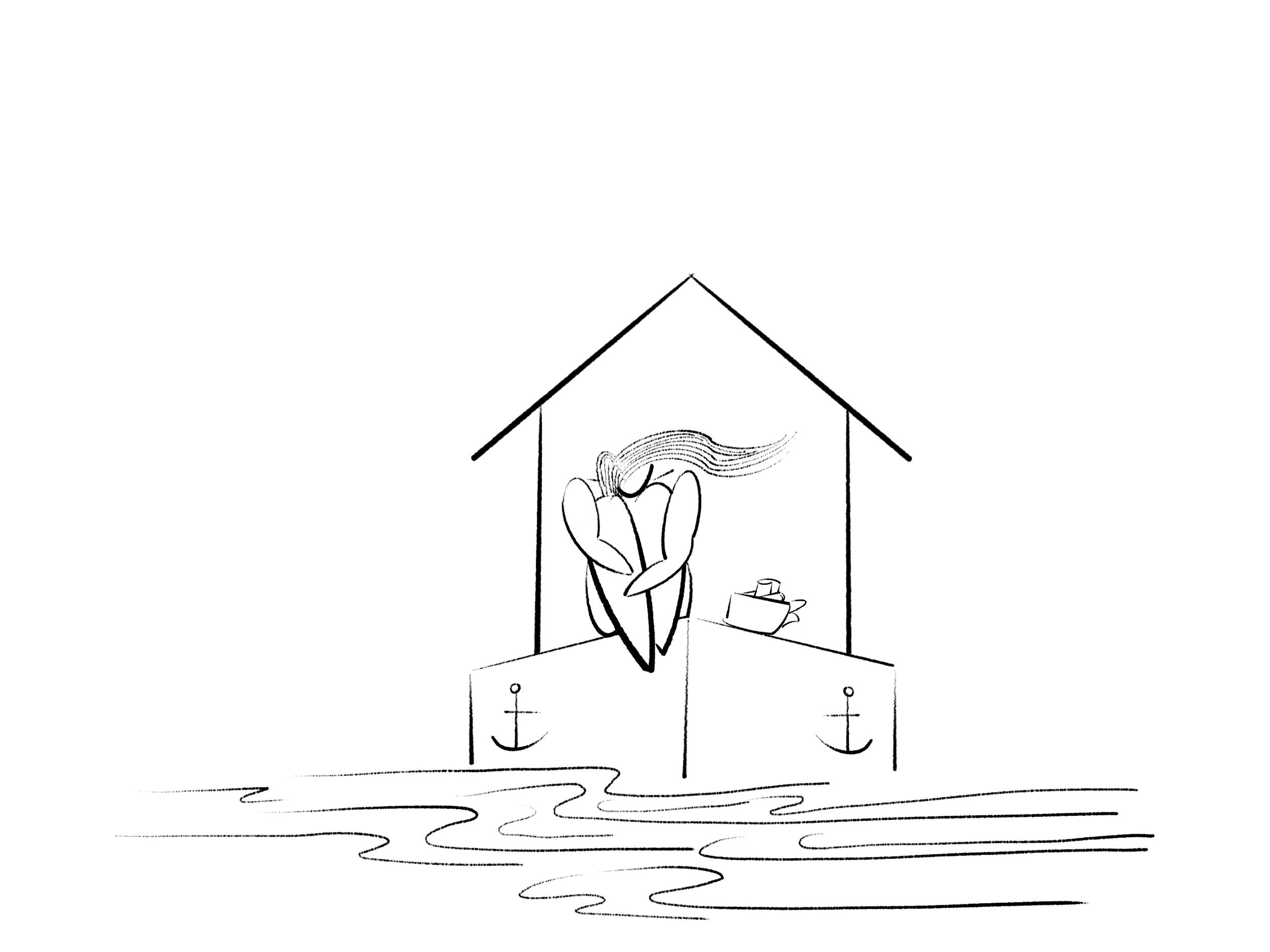
Illustrated by Tian Tian
Sometimes romance isn’t found in movies and books but in everyday life and fleeting moments. Recently, I visited Leigh-on-Sea, a small seaside town in the east of England. Those two days were blessed with rare, bright sunny weather that drew out both locals and visitors. But unlike Brighton or Margate, the town remained quiet, which was precisely why I went there.
In the morning, while wandering towards the seaside near the station, I noticed many stalls at the seaside plaza where I had taken sunset photos the previous night. It was Sunday – a market day, and buyers and sellers were chatting like friends. If you liked something, you bought it. The prices of some small paintings shocked me. Their quality was subjective – if you liked it, it was worth it. I strolled around lazily until my eyes were drawn to a stall with sculptures. I stood still, mesmerised by the view. There were only a few “poorly made” sculptures on display, resembling open books with their pages twisted together. These sculptures were unique, requiring a special aesthetic to appreciate. There was no price tag, and I wouldn’t buy one anyway, but I was captivated by the design. Next to the sculptures there were two long scroll-like architectural drawings displayed on an easel. It was still early, and not many people were around. The stall owner, dressed in red, greeted me warmly. I felt strangely drawn to and familiar with these three sculptures, as if re-encountering an old lover. I sensed a story behind them. Art and religion often cure loneliness. I followed the artist into the story of her sculptures. The sculptures were created for her husband, who had passed away 50 months ago, she whispered to me. Looking at the sculptures, I closed my eyes to better channel my emotions. I told her that the shape of the porcelain sculptures must have felt like touching her husband’s skin. As I spoke about these tactile sensations, I could describe them with precision – it felt natural to do thiswhen discussing beautiful things. The words came effortlessly, flowing directly from my lips in an unstoppable stream. She nodded excitedly, saying, “Exactly, it’s the same as talking to my husband.”
The outermost dark brown part of the sculptures was made from her husband’s leather wallet, and the pages inside were taken from the Bible; her husband was a man of faith. I asked if she would be willing to part with these unique sculptures. She said, “Each time it’s like a small exhibition; whether people buy them or not doesn’t matter.” To me, these weren’t just sculptures; they were true art, representations of true love in life.
We often question the meaning of life in this world. How absurd is our repetitive and seemingly meaningless existence? Encountering this woman and hearing her story made me reflect. It brought me into close contact with kind people. She could recall precisely how many days her husband had been gone. Halfway through our conversation, she stepped aside to compose herself; possibly to cry. I asked if she lived nearby. She pointed to a row of boats in the distance, indicating her home – the largest houseboat at the far end. I asked if it would be convenient to stay the night, offering to pay to sleep on a bunk. She explained that the boat had two bedrooms and two bathrooms, one reserved for guests, and a large kitchen. Her husband had spent two and a half years building the houseboat, and though he was no longer with her, she continued to live in the harbour. That boat was like his body, always protecting her. She breathed him in with every drop of air.
The pursuit of love varies greatly between China and the West, though necessity remains a constant everywhere. A popular saying among young adults in China is, “I’d rather cry in a BMW than laugh on the back of a bicycle.” It seems that materialism has overtaken everything, making genuine connections increasingly rare. Conversations often revolve around money, cars and houses. People compare the size of their home, its proximity to the city centre, or the brand of their cars. A friend of mine who had lived in Germany for years returned to Beijing to catch up with old friends, only to find both the conversations and the people she once knew had changed beyond recognition. If a marriage isn’t based on love, it is destined to struggle. In the West, it’s more common to see couples come together because they are soulmates.
At the place I stayed in Leigh-on-Sea, there was a large piece of artwork framed in delicate wood, hanging at the entrance. It marked the number of days the couple had spent together, up until the 6th of September, 2023. Though I only stayed two nights, it felt like a lifetime’s lesson in happiness. The hosts spoke little, but rather immersed themselves in books. Love, for some, it seems, is not about wealth or possessions, but a carefully decorated home, a record of shared days, and time spent reading together.
Life has no definitive meaning, nor is there a right or wrong way to live. Life goes on, much like Sisyphus, endlessly pushing his boulder uphill. There is no winning or losing, no ultimate purpose or outcome. Nor should life’s meaning be measured by any external scale. The meaning of life – if there is one – lies in finding possibility within the impossible, in continuing even when the fuel runs out. It’s a difficult journey, one that demands positivity even in discomfort. But within that lies possibility. How can you see it unless you forge ahead? It’s a daunting path, often swallowed by darkness, but standing at the summit, you realise that every effort has only made you stronger and you see light guiding your way on the distant horizon.
When you gaze at the earth and the sun, you are empowered to shoulder all difficulties. Only then do you realise you have truly lived in this world, driving away emptiness and absurdity. Temptations no longer trouble you. Living is the meaning of existence! Be it on the boat near the coast where a widowed woman honours her husband, or during my own slow journey of self-discovery, I found not only love but also a profound answer to my search for the meaning of life in these “small” yet significant sculptures.
About the author
Sun Hong (pen names: Zixiao, Sun Baiding) holds a master’s degree in Museum Studies from the University of Leicester and a master’s degree in Curating Cultures from SOAS, University of London. As a senior cultural and art lecturer, Sun Hong also volunteers for several museums and charitable organisations.
有些浪漫,不在电影和书里,而是在平常的日子里,在擦身而过的瞬间里。前阵去英国东边的海边小镇滨海利(Leigh-on- Sea),那两天是久违的大晴天,天气好得让本地人和外地人都冒出来了,但小镇相比布赖顿(Brighton)、马尔盖特(Margate)还是清静很多,所以我来了。
晨起,往车站方向的海边晃悠,忽地,看到昨晚拍日落的海边广场有很多摊位。哦,今天是周日,通常有市集的。这里没有那么强的商业意识,买家和卖家跟朋友一样聊着家常,喜欢就买走。看着这些小画的价位,有时还挺吓人的,画技吧,不好说,喜欢就值。我正懒散地一路晃着,视线突然被一个摊位的雕塑拴住了,脚一动不动地定在那里。只有几个“丑丑的”雕塑摆在摊位上,再看,分明是书本的样子。书本是打开的,里面的纸张扭扭捏捏地放置在一起。很少有雕塑长成这个样子,但我喜欢。雕塑很怪,很特别,而且是书本的样子,长得不好看,像未完成品,买家需要特别的审美。上面没标多少钱,我也不会买,但我对这个设计太感兴趣了。旁边的画架上分明是两个长卷式的建筑图纸立面图。因为很早,人也不多,摊主穿着红色衣服热情地招呼我。我觉得自己像个怪人,对那三件雕像的痴迷像是望见了老情人。
艺术和宗教是治愈人内心的荒芜的,我猜测这里面必有故事。之后,我便走进了她创造的雕塑世界里。这些雕塑是她为先生创作的,他走了 50 个月,女人轻轻细语道。看着眼前的雕塑,我可以闭着眼睛说出内心的感受。没有原因,天生的。我说她在做瓷器雕塑时,手指触摸这些瓷土时,手指尖在表面滑动时,就跟触摸她先生的皮肤一样。聊这些肢体感受时,我能聊得很贴切,一种天生的对美好事物的感受。言语不用组织,一个个词排着队站在嘴边,不用思考直接流淌,是抑制不住的那种流淌。女人激动地说,“对对对,就是这种感觉,我一直在跟去世的他对话。”
雕塑的最外面深棕色的部分是用他先生的皮钱包做的,里面一页页纸是《圣经》的内容,他先生是有信仰的人。我问,你舍得卖这几个独一无二的雕塑么?她说:“每次就像开个小型展览一样,人们买不买根本无所谓。”在我眼里这根本就不是雕塑,这几件作品在我眼里可真是美极了。它让我看见了人世间最美的情爱!我们总会追问,活在世上的意义是什么,这种重复而无意义的生活是多少荒谬,在荒芜之中,如果遇见这样的故事,做如何想?它让我唤起对世间那种特别美好情感的近距离接触。她能清楚地说起,她先生离开她多少天。中途她跑到旁边去擦鼻子,不知有没有泪一起流。我问她是否住在这里?她拉着我走到海边位置,指向远远的一排船,她家是远方最大的那个船屋。我问方不方便住她家地板?我会付钱的。她说,有客房,2 室 2 卫,大大的厨房。然后最让我听傻了的是,她说她先生用了两年半造了这个船屋。原来,她一直都住在他的身体里,即使他已经离去。这个船屋就是男人的身体,无论何时,都在护佑着他的女人,在每一片船屋木屑的呼吸里。
对人间情爱的追求,东西方的差异还是挺大的。但无论生活在哪里,基本物质保障是一切的前提。中国的年轻人里,曾有一位这样表达自己的恋爱观:“我宁愿坐在宝马车上哭,也不愿意坐在自行车上笑。”如果单纯从字面上理解,物质已经碾压一切,什么精神交流和灵魂伴侣,在现实生活里越来越缥缈,不切实际。金钱、车子和房子,这是大家聚在饭桌前谈论的焦点,就是比如你家房子多大、在几环,开什么牌子的车子。好友在德国生活多年,回京和老同学聚会,在饭桌前变得无话可讲,这些话题根本不是她常年在德国谈论的,老同学们似乎也不那么熟识了。如果嫁给一个人并不是嫁给感情,在这样的情境下走在一起的两个人,将来的婚姻幸福指数需要打几个问号。但在西方,常常接触到一些为精神而走在一起的人。就像我这次住在这里的民宿,门口墙上挂着一张大大的艺术品,用精致的木框装裱,上面写的是一串数字,到 2023 年 9 月 6 日两人一起走过了多少天。我本来一早已经离开了住宿地,又特意跑回去祝福房东。只住了两晚,感觉上了一堂人生的幸福课程。房东两人也不太主动和客人聊天,一人捧着一本书。爱情不是物质的房子、车子,而是一座亲手制作的家屋、一面挂在墙上的一起走过日子的记录板、一起读书的样子!
在我看来,人生没有意义,也没有对错。一遍遍走过,就像那个西西弗斯,执着地一遍遍推着那个巨大的球往山上爬。人生没有输赢,也没有目的和结果,更别想以各种尺度来丈量一个人活着的意义。人生的意义就是即使车没油了,跑不动了,得想办法接着走。意义就是在不可能里寻找意义、寻找可能。这是一条异常艰辛的路,因为自己主观上要一直积极向上,而且常在一种极不舒服的状态里。可是,可能性就在此处,世界的尽头就是光,不走怎么能见到。这恐怕也是让大多数人不愿选择人在旅途的原因,路长且险峻,似乎黑暗吞没了一切。但当你站在一个个山巅时,你会觉得所有的一切让你又多了一分力量。你在远方的地平线里,看见光在为你独舞。当你和大地、和太阳遥遥相望时,你会觉得自己不可承受的生命之轻似乎有了一点点重量。我存在,踏踏实实地存在,我有了一粒尘的重量,空虚和荒谬早已被我驱逐,我也无暇被种种诱惑所困挠。活过,就是存在的意义!无论是在船屋的爱人身体里,还是在自我的漫漫旅程里,从这几件“小小的”的雕塑里,我读到了不只是爱情,更是对生命意义的寻找。
作者介绍
孙宏(子小、孙白丁),英国莱斯特大学博物馆专业硕士,英国SOAS 大学策展专业硕士。资深文化艺术讲师,多家博物馆和慈善机构志愿者。
Both the Chinese and English editions of Haha! Britain can be purchased at the following platforms:
· BOOK FAN