[Interview] Everyday Life Across Cultures: Mu Zijing Discusses “Deutschland mit einem Augenzwinkern (Germany with a Wink)” with the International Cultural Exchange Dream Workshop
New Book Release
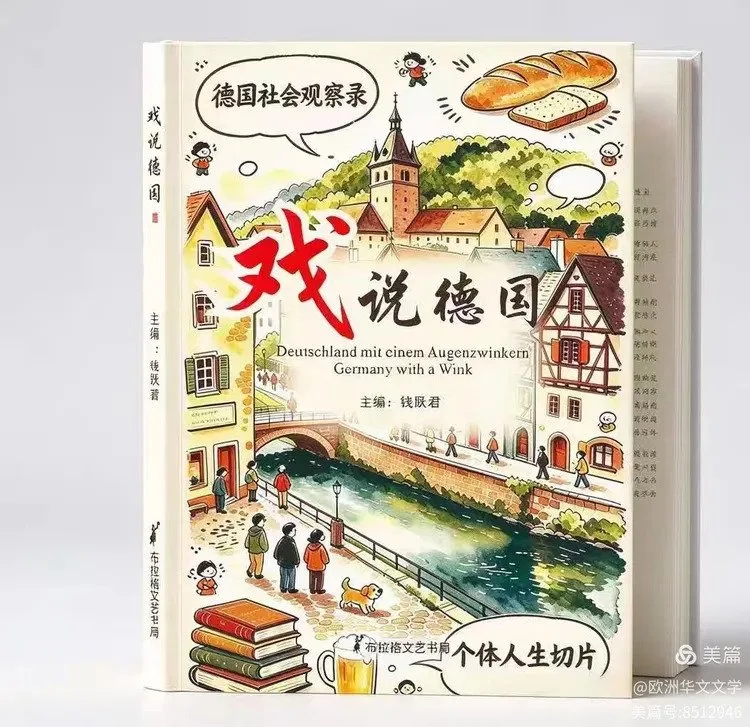
A collection of stories capturing the many faces of life in Germany
Editor-in-Chief: Dr Qian Yuejun
Contributors: A Cheng, Mu Zijing, Ye Xin, Mao Lizi, Piao Kangping, Hui Juan, Jing Shui, Gao Beiming, Mu Mu, Guo Li, Ya Lan, Huang Yuxin, Gou Sheng, Lao Xia, Xi Yue, Pan Yiling, Qian Yuejun, Jiu Ping'er, Ni Na, Yan Ding, Yan Jun, Xu Mei, Yu Fang, Yu Heng, Ding Ning, Xia Yang, Ping Ping, Xie Shengyou, Wang Lifan, En Li, Ma Zhenzhou, Hong Zhong, Xia Qingqing, Xu Jianjia, Yang Yue, Wang Yingzi, Zhang Ye, Xiao Yu and Xi Jian (listed in order of appearance).
To order, please email: germany@chinesen.de
Everyday Life Across Cultures
Mu Zijing on Deutschland mit einem Augenzwinkern (Germany with a Wink)
What Kind of Book Is This?
Edited by Dr Qian Yuejun, Deutschland mit einem Augenzwinkern (Germany with a Wink) is a collection of essays and true-life stories written by 39 Chinese people living in Germany. Bringing together writers from several generations, it recounts their experiences of life in Germany from the 1980s to the present day, exploring cultural encounters, personal observations and reflections.
The book is neither a tourist's guide to German customs and attractions nor an abstract critique of cultural differences. Instead, it is firmly rooted in everyday experience, drawing on the joys, sorrows, relationships and struggles of ordinary people to create a dialogue between Chinese and German cultures.
At approximately 155,000 Chinese characters, the collection brings together contributors of different ages and professional backgrounds, including students, engineers, teachers, businesspeople, homemakers and creative practitioners. Their observations and experiences, gathered over decades of living abroad, form a rich and vivid portrait of Chinese life in Germany.
The Chinese title, Xi Shuo Deguo, suggests a light-hearted, conversational approach to Germany, but the book is far more than a collection of amusing anecdotes or curious encounters. Its humour serves a deeper purpose. By setting aside grand narratives and simplistic judgements, the contributors examine German society, and their own cultural backgrounds, with curiosity, humour and an awareness of life's difficulties.
Many of the contributors arrived in Germany during the 1980s and 1990s, a period when the differences between Chinese and German society were particularly striking. They were both outsiders observing an unfamiliar country and active participants in its everyday life. They recognised the strengths of German institutions and traditions while remaining attentive to social tensions, prejudice and the complexities of human behaviour.
In his introduction, Dr Qian recalls arriving in Germany in the early 1980s. His memories capture the atmosphere of a particular historical moment. China was still in the early stages of reform and opening up, and material conditions remained modest. For Chinese students arriving in Frankfurt, universities without enclosing walls, extensive social welfare provisions and unfamiliar ways of life came as a considerable cultural shock.
Those government-sponsored students worked exceptionally hard and earned widespread respect in German academic circles. Yet behind their achievements lay considerable financial hardship. Many lived frugally, saving whatever they could to buy household appliances for relatives back in China while carrying the weight of family responsibilities.
By recovering these increasingly overlooked experiences, the book also provides a valuable historical record of an earlier generation of Chinese people in Germany.
The collection is divided into four sections: Entering German Life, The Many Faces of German Society, Working and Doing Business in Germany, and Raising Children Abroad.
Together, they take readers from the initial shock of encountering a new culture through the people and communities of everyday German life, the challenges of employment and business, and finally into the more intimate worlds of family, parenting and personal relationships. The result is a wide-ranging portrait of Chinese experiences in Germany.
The Many Faces of German Society
Many essays in this section explore the cultural differences encountered by newcomers.
A Cheng's Life in a German Village is particularly warm and moving. Following her divorce, the author moves to the German countryside with her dog. When her garden becomes overgrown, neighbours she barely knows arrive with tools and voluntarily help her tidy it, expecting nothing in return.
Their kindness is neither demonstrative nor motivated by personal advantage. German neighbourliness may be understated, but it can be remarkably dependable.
During the pandemic, she turns her garden into an informal hairdressing space, cutting neighbours' hair and helping an elderly woman with limited mobility.
The author identifies something fundamental about German society: order provides its structure, but spontaneous acts of kindness are what bring it to life.
The essay also introduces readers to Germany's extensive network of voluntary associations, known as Vereine. These include local heritage societies, volunteer fire brigades and Franco-German friendship associations. Such organisations provide ordinary citizens with opportunities to participate in community life and offer an important insight into German civil society.
People often associate Germany with discipline and respect for rules, overlooking the vital role that voluntary associations play in connecting communities.
For newcomers, genuine integration means more than learning the language and finding employment. It also means becoming involved in the wider life of the community.
Mu Zijing's Theo's Masterpiece, from the same section, is a gentle story filled with humanity.
Theo, a lively and unconventional hairdresser, is fascinated by the dark hair of East Asian women. When he attempts an unusual colouring treatment on the Chinese protagonist, the result is a comical disaster.
Life subsequently takes Theo through several difficult turns. After becoming seriously ill, Theo makes the courageous decision to transition and takes the name Thea.
The salon's regular customers continue visiting as before. Rather than allowing social prejudice to define their relationships, they value the person they have come to know.
In a few short pages, the story offers a glimpse of German society's capacity to accept individual differences. This acceptance is expressed not through political slogans, but through the everyday kindness of ordinary people towards those whose lives differ from their own.
Ye Xin's First Marriages turns to marriage and family life, examining the considerable differences between Chinese and German attitudes towards relationships.
Divorce and remarriage are common in Germany, and blended families are an established part of society. Social expectations and family pressure generally exert less influence over people's decisions to marry or separate, while the legal system provides a framework for divorce.
Children growing up in blended families do not necessarily experience serious psychological difficulties.
Rather than idealising the German approach or simply criticising Chinese marriage traditions, the author considers the social factors behind these differences, including legal structures, public attitudes and contrasting understandings of intimate relationships.
Mu Mu's The Wild Side of Germans offers a frank examination of cultural differences surrounding sexuality and gender.
Drawing on personal experience, the author contrasts the restraint traditionally associated with Eastern attitudes towards sex with the more open discussion of desire in German society.
Her writing is bold and sincere, avoiding both moral superiority and uncritical admiration. Cultural differences are explored through the lived experiences of women and the ways in which different societies shape their understanding of themselves.
Finding a Place in German Society
One of the greatest strengths of Deutschland mit einem Augenzwinkern (Germany with a Wink) is its refusal to present Germany through an idealised lens.
The book portrays a society populated by kind and generous individuals, but also by people who can be narrow-minded, stubborn or selfish.
Gou Sheng's short story Memories Buried in Dust is particularly poignant. It recounts the tragic experience of Lao Qin, a Chinese student living in Germany during the 1980s.
Burdened by family responsibilities in China, Lao Qin secretly takes a job washing dishes while studying, working tirelessly to send money home.
He struggles to balance demanding academic work with physically exhausting employment. When news arrives that his son has been involved in a road accident, the additional emotional strain becomes almost unbearable.
Years of physical and psychological exhaustion eventually take their toll, and he dies far from home.
The story reveals a less familiar side of the early generation of government-sponsored Chinese students.
Often remembered as exceptionally talented scholars who achieved academic success abroad, some also carried enormous family expectations and struggled to survive under difficult circumstances.
It is a sobering reminder of how the pressures of a particular historical era could shape, and sometimes overwhelm, individual lives.
Jiu Ping'er's The Quiet German Neighbour explores neighbourhood disputes, challenging the stereotype that Germans are invariably friendly and tolerant.
The author's family repeatedly receives complaints from a neighbour simply because someone plays the piano or the children make noise at home.
The neighbour carries unresolved emotional wounds, and her loneliness and frustration have gradually turned into hostility towards those around her.
Rather than condemning her outright, the essay attempts to understand the pain behind her behaviour.
True peace, it suggests, comes from inner calm rather than demanding absolute silence from the outside world.
Ni Na's essay Deutschland mit einem Augenzwinkern (Germany with a Wink) offers an even sharper examination of German society.
It acknowledges the country's strengths, including universal healthcare and an extensive public transport system, while also highlighting slow digital development, bureaucracy and wider social contradictions.
The author's perspective is clear-eyed: no country is perfect. Germany can be rigid and frustrating, but it also possesses a sincerity and straightforwardness that make it a place worth appreciating.
Several contributions examine the multicultural realities created by immigration and refugee movements.
In his introduction, Dr Qian recalls Germany's assistance to ethnic Chinese refugees from Vietnam and its later reception of refugees from Syria and Ukraine. He also acknowledges the inevitable tensions that arise when people from different cultural backgrounds live together.
Ding Ning's Ten Years to Sharpen a Sword describes her entrepreneurial experience of employing Afghan refugees.
Working alongside people of different ethnic and religious backgrounds can lead to disagreements and conflict, but goodwill can also help overcome cultural barriers.
Yan Jun's Stones of Remembrance and a City That Dances takes readers to Cologne, where the author encounters the Stolpersteine, or stumbling stones.
These small brass plaques, embedded in pavements, commemorate individuals persecuted and murdered under the Nazi regime, including Jewish victims.
This distinctive form of public remembrance represents an effort to confront one of the darkest chapters in German history.
The weight of historical memory exists alongside street performances, humour, music and the everyday enjoyment of city life.
Remembering suffering without allowing it to extinguish the joy of living is one of the most striking aspects of Germany's engagement with its past.
Working and Doing Business in Germany
This section turns to the experiences of Chinese people navigating Germany's workplaces and business environment.
Most of the contributors draw on their own professional journeys, sharing stories of achievement alongside mistakes, setbacks and difficult lessons.
Yu Fang's One Street, One Grandmother and Two Thousand Marks is especially touching.
During the 1980s and 1990s, Yu Fang is a Chinese student whose German is still limited. Through the kindness of her elderly German landlady, she is introduced to a business owner.
The businessman offers to lend her 2,000 Deutsche Marks as start-up capital, enabling her to explore opportunities in the Chinese market.
There is no elaborate business plan. The arrangement begins simply with trust between individuals and eventually develops into a venture in Sino-German technology trade.
More than a story about entrepreneurship, the essay captures the warmth and generosity that can emerge through relationships across cultures.
Yu Heng's Bound to Germany: A Journey Through Business and Art covers an extraordinary range of experiences.
The author recalls falling victim to a commercial fraud in Germany during the 1980s, taking the dispute to a German court and successfully defending his interests.
He later returns to China to establish a business, introduces Düfa environmentally friendly water-based paints to the Chinese market, and develops a collection of internationally significant antique musical instruments, using art as another means of connecting China and Germany.
The essay combines the drama of commercial disputes with a commitment to art and philanthropy.
It reflects the varied ambitions of a generation of Chinese people abroad, whose aspirations extended beyond financial success to the pursuit of cultural meaning.
Dr Qian's Looking for Work in Germany recounts the amusing and sometimes awkward experiences of job interviews and employment searches.
Written with the distinctive humour of an intellectual observer, it captures both the difficulties and opportunities facing foreigners seeking work in Germany.
Wang Lifan's Life as a Landlord draws on more than thirty years of experience in property ownership.
Through detailed accounts of housing regulations, historic building preservation and relationships between landlords and tenants, the author brings German property law to life.
Real disputes, unexpected acts of kindness and everyday practical problems turn otherwise abstract legal provisions into recognisable human stories.
Raising Children Abroad
The final section focuses on parenting and education, areas in which Chinese families living overseas often experience some of the most striking cultural differences.
In his introduction, Dr Qian contrasts Chinese and German approaches to raising children.
In many Chinese families, several generations devote considerable attention to a single child. In Germany, children are regarded as a responsibility shared by society, with their welfare given priority in legal and institutional decisions.
Children are also encouraged to become independent and take on responsibilities at home from an early age.
Yet this does not necessarily mean that childhood is entirely carefree.
The editor raises a further question: if competition is played down too much, how well will children be prepared for the demands of adult life?
Yang Yue's two essays, An Unforgettable German Reading Competition and The Piano Competition, describe the experiences of children of Chinese heritage taking part in competitions in Germany.
German children appear relatively relaxed about winning and losing. They are less burdened by the pressure to succeed, and competitors are more inclined to congratulate one another sincerely than to feel jealous.
This contrasts sharply with the atmosphere often associated with similar competitions in China.
Xie Shengyou's Reflections on a Traffic Fine and En Li's The Debate Over Secondary School Uniforms use small incidents from everyday life to explore German educational values.
These include respect for civic rights and responsibilities, recognition of children's individual aesthetic preferences and a reluctance to impose uniform standards that suppress individuality.
Writing Style
The writing in Deutschland mit einem Augenzwinkern (Germany with a Wink) is one of its most appealing qualities.
Each of the 39 contributors has a distinctive voice.
Some write with restraint and emotional depth. Others are witty, outspoken or irreverent. Some bring the literary refinement of an older generation of intellectuals, while others favour lively, down-to-earth accounts of ordinary life.
Despite these differences, the contributors share an important characteristic: they resist simplistic labels and black-and-white judgements.
When writing about Germany, they neither uncritically praise its institutions nor mock the shortcomings of Western society from a Chinese perspective.
When reflecting on Chinese culture, they recognise the warmth and value of its traditions while remaining willing to question established assumptions and limitations.
Strengths and Limitations
The value of this collection extends beyond its portrayal of Germany.
At a deeper level, it uses life in another country as a mirror through which Chinese readers can reconsider their own society.
When people live between cultures, familiar beliefs, customs and habits of thought are often brought into sharper focus.
A Cheng's account of neighbourly kindness in rural Germany invites reflection on the strengths and weaknesses of Chinese social relationships.
First Marriages encourages readers to reconsider the meaning of marriage and individual choice.
The essays on parenting raise questions about what constitutes a fulfilling childhood and what it truly means to care for children.
Lao Qin's tragic story in Memories Buried in Dust reminds us of the pressures ordinary individuals faced during a period of enormous historical change, particularly the responsibilities that earlier generations carried towards their families and homeland.
The collection also preserves valuable material relating to the history of Chinese-language literature in Europe.
Dr Qian recalls the establishment of Rhine Correspondence and European Chinese Herald during the 1980s.
Among the earliest Chinese-language publications founded by Chinese residents in Germany following China's reform and opening up, these newspapers received support from figures in German political life and became important platforms for Chinese-language writing overseas.
Many contributors to Deutschland mit einem Augenzwinkern (Germany with a Wink) began their writing careers through these publications and have continued writing for decades.
Chinese-language literature produced in Europe has often remained outside mainstream literary attention.
By bringing together writers from several generations, the collection transforms individual recollections into a shared cultural memory.
Published in 2026, Deutschland mit einem Augenzwinkern (Germany with a Wink) looks back over more than forty years of Chinese life in Germany while preserving a vivid record of ordinary experiences for future generations.
The book is not without limitations.
With so many contributors, the quality of the writing inevitably varies.
Some essays rely heavily on personal reflection without exploring the wider social issues in sufficient depth.
The collection also concentrates largely on the experiences of middle-class and more affluent Chinese residents, offering relatively little insight into the lives of lower-paid Chinese migrant workers.
Other contributions are retrospective accounts shaped strongly by individual memories and feelings.
These can be deeply moving as literature, but they should not be mistaken for rigorous sociological research.
Yet this is also consistent with the spirit of the book's title.
Deutschland mit einem Augenzwinkern (Germany with a Wink) does not claim to be an academic study. It is a collection of personal observations, experiences and reflections by ordinary people who have made their lives far from home.
Understanding Germany
Even today, attitudes towards Germany in China often fall into two opposing camps.
Some idealise the country as a model of discipline, prosperity and generous social welfare.
Others focus almost exclusively on its problems and contradictions, dismissing German society altogether.
Through its many small, authentic stories, Deutschland mit einem Augenzwinkern (Germany with a Wink) challenges this simplistic divide.
Germany is neither paradise nor a place of unrelenting hardship. It is a real society made up of millions of ordinary people.
Its institutions can be rigorous, but its bureaucracy can also be inflexible.
Kindness and tolerance are widespread, yet prejudice, indifference and selfishness still exist.
The country's difficult historical reflections are literally embedded in city pavements through its stumbling stones, while the streets around them remain full of humour, activity and the pleasures of everyday life.
Chinese people living overseas inhabit two cultural worlds.
They look back towards their homeland while learning to understand the society in which they now live.
The stories in this collection remind us that cross-cultural understanding is not about deciding which civilisation is superior.
It does not require us to embrace everything about another country or defend every aspect of our own traditions.
Instead, it means recognising the strengths and limitations of different cultures, reflecting on our own assumptions and learning to appreciate the complexity and diversity of human experience.
Perhaps this is the book's most important message.
Wherever we live, institutions and cultures provide the framework of society. But what matters most are the lives within that framework: the joys and sorrows, struggles, kindnesses and imperfections of ordinary people.
About Mu Zijing
Mu Zijing is a Chinese writer based in Germany. She is currently Editor-in-Chief of the annual publication European Chinese Literature and Editor-in-Chief of Prague Literary Publishing House.
She is a lifetime member of the European New Immigrant Writers Association, a council member of the Fudan University Alumni Association in Germany, a member of the Chinese Poetry Society, a council member of the European Chinese Writers Association and Honorary President of the Lushan Tao Yuanming Poetry Society in China.
She is also the founder of the European Chinese Poetry Society's WeChat platform and served as a specially appointed professor at Yancheng Teachers University from 2016 to 2023.
A prolific writer, Mu has published across a wide range of genres, including essays, fiction, poetry and literary criticism.
Her works include the essay collection Returning to Eden, the short story collection Beside the Lake of Returning Dreams, the fiction collection Affairs of the Heart, and the poetry collections Crossing the River of Fire and As Though Facing My Reflection.
Her other publications include the selected works Fragrance at Dusk, Thoughts of You; the novels Living After Nazism, also known as After the War, which received second prize at the 2023 Keda Cup Second Silk Road Cultural Competition and the Novel Award at the 2025 World Chinese Literature Peace Awards; Drunken Peace, which received second prize at the 2026 Third Silk Road Cultural Competition, organised by the Chinese Modern Literature Society under the Yuke Yuan Cup; and A Heart Pure as Ice in a Jade Vessel.
She has also published the three-volume literary criticism collection Fragrance in Hand, the essay collections Little Fragments, Imprints of Time and Traces of the Years, the family biography A Meeting Beneath the Stars, and the German-language Jenny Li Anthologie, Volumes 1–9.

About the International Cultural Exchange Dream Workshop
Culture flourishes through exchange, and civilisations are enriched through mutual understanding.
The International Cultural Exchange Dream Workshop is dedicated to building a global platform for cultural collaboration, transcending national boundaries and breaking down barriers.
Our aim is not simply to create connections, but to establish a creative space where inspiration can flourish and new ideas can take shape.
Our mission is to bring people together through culture and drive progress through innovation.
We encourage the exchange of diverse perspectives, promoting dialogue between different civilisations and enabling cultures to learn from and enrich one another.
From traditional artistic treasures to pioneering digital creativity, we seek to provide an environment in which ideas can take root and grow.
We believe that every dream capable of crossing cultural boundaries deserves to be recognised.
Together, we aim to turn diverse cultural visions into meaningful connections across the world, allowing the voices of different civilisations to resonate on a global stage.

About Prague Literary Publishing House
Prague Literary Publishing House is a publishing organisation dedicated to supporting Chinese-language writers in Europe and nurturing the development of Chinese-language literature.
Founded in December 2015 in Prague, a city renowned for its literary atmosphere and rich cultural history, the publishing house began as an initiative established by Chinese-language writers living in the Czech capital who wished to publish their work in Europe.
As Chinese-language culture continued to develop and interact with European society, the organisation gradually evolved beyond its original publishing purpose.
What began as a means of helping individual writers bring their books into print has grown into a broader literary publishing platform serving Chinese-language authors across Europe.
Its activities have expanded from supporting writers who struggle to find publishing opportunities and producing high-quality literary works to publishing the journal European Chinese Literature.
The journal provides a platform for writers, their works and literary criticism, bringing together different voices within the European Chinese-language literary community.
Alongside literary writing, publishing news and reviews, it also features a dedicated section encouraging children of Chinese families in Europe to write in Chinese.
Through this initiative, the publishing house hopes to nurture young people's interest in Chinese-language writing and help them maintain a connection with their cultural heritage.
In doing so, it seeks to serve as a bridge for cultural exchange between China and Europe.
Since its establishment, Prague Literary Publishing House has remained committed to its founding principles: bringing people together through literature, building connections through books, supporting Chinese-language writing and encouraging emerging literary talent.
We are more than a publishing house. We are also a platform for cultural exchange.
We work to identify and promote outstanding Chinese-language literary works, offering Chinese communities across Europe the comfort of reading in their mother tongue and a sense of connection to their cultural roots.
At the same time, we actively introduce European literary and artistic works to Chinese-speaking readers, helping to overcome language barriers and creating opportunities for people from different cultural backgrounds to encounter and understand one another through literature.
We believe that books speak a language that transcends borders, and that literature and art can build bridges between hearts and minds.
Prague Literary Publishing House hopes to remain a welcoming beacon beside the River Vltava, offering warmth, inspiration and a place of intellectual belonging to everyone who loves literature, seeks understanding and finds wonder in the world.